Choosing food packaging materials is a practical decision, not a simple contest between “green” and conventional options. Global buyers must compare product protection, transport weight, sealing performance, available recycling systems, and reliable supply. A crisp snack may need a strong moisture barrier; a glass jar can protect a sauce but adds shipping weight. Small details matter.
The OECD’s Global Plastics Outlook (2022) estimates that packaging generated about 40% of global plastic waste in 2019. FAO’s The State of Food and Agriculture 2023 reports that roughly 13.2% of food was lost after harvest and before retail in 2021. These figures describe different challenges, but they belong in the same purchasing conversation: packaging should protect food while limiting avoidable material impacts. That balance is not always obvious.
This guide reviews ten widely used options, including paperboard, glass, aluminum, rigid plastics, flexible films, and molded fiber. Each has trade-offs. Paper-based packs may need coatings; lightweight films can be difficult to recover in some markets. A material’s real-world performance also depends on pack design, local collection infrastructure, and the food itself. There is no universal winner. Buyers should verify supplier specifications and assess the destination market rather than relying on broad claims. The comparisons ahead offer a grounded starting point, not a substitute for product testing or local expertise.
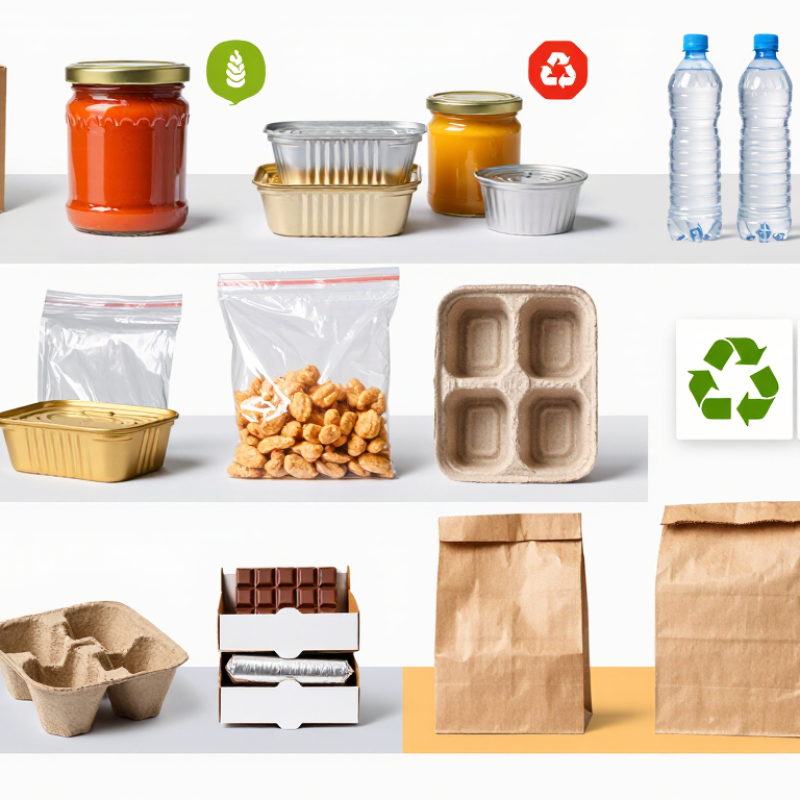
Top 10 Food Packaging Materials for Global Buyers?
How Global Buyers Evaluate Food Packaging Materials
Global buyers compare food packaging materials by product protection, transport conditions, local recycling options, and total delivered cost. A dry snack may need strong moisture protection, while fresh produce needs ventilation and careful temperature control. Small details matter. A weak seal or crushed corner can undermine an otherwise suitable material.
Food loss also shapes packaging decisions. FAO’s 2019 State of Food and Agriculture estimated that 14% of food was lost between post-harvest and retail in 2016. Packaging cannot solve every cause, but the right barrier and pack size can help protect products during storage and transit. Buyers should test filled packs under real shipping conditions, not rely on a supplier’s sample alone.
End-of-life performance deserves equal attention. The OECD’s Global Plastics Outlook reports that packaging generated about 40% of global plastic waste in 2019. That figure makes recyclability a serious purchasing factor, but “recyclable” on paper may mean little where collection systems are limited. Compare paper, glass, metal, and plastic options against local infrastructure, food-contact requirements, and product shelf life. I would not assume one material is best everywhere; even a promising choice can fail when humidity, shipping distance, or sorting capacity changes.
Paper, paperboard, and molded fiber suit different packaging jobs. Paper wraps lightweight goods and forms flexible bags. Paperboard provides a stiffer surface for cartons, sleeves, and folding boxes. Molded fiber protects irregular products with shaped cavities, such as bottle necks or small electronics. A snug fit matters.
Material choice depends on weight, moisture, and handling. A carton that feels sturdy in a dry shop may soften in a chilled delivery box. Paperboard can take coatings for grease or moisture resistance, but some coatings complicate recovery. Molded fiber cushions well, yet thin sections may crack under repeated impacts. Test the actual pack, not just a sample sheet.
Scale supports the category, but does not prove every format is recyclable locally. Eurostat reported that paper and cardboard made up 40.8% of EU packaging waste by weight in 2022. In the United States, the American Forest & Paper Association reported a 68% paper recycling rate for 2022. These figures describe different regions and systems. Check local collection rules, then test stacking strength, humidity exposure, and damage rates during transit. Small details matter.
Representative thickness of commonly used food-packaging materials, shown in millimeters. Actual specifications vary by product design, barrier requirements, and manufacturing process.
Paper and paperboard are lightweight options for wraps, cartons, and sleeves, while molded fiber is typically thicker and more rigid for trays, bowls, and protective inserts. Flexible films and aluminum foil provide thin barrier layers, whereas glass and metal containers offer greater structural strength.
Global food buyers often compare plastic films, rigid plastics, and bioplastics before choosing packaging. The right material depends on shelf life, filling speed, transport distance, and recycling access. Flexible films use less material than many rigid formats, but multilayer structures can be difficult to recycle. The OECD Global Plastics Outlook reports that packaging creates about 40% of global plastic waste. That figure makes material selection a procurement issue, not only a design decision.
Rigid plastics provide useful strength for yogurt cups, trays, and bottles. They protect food during stacking and reduce crushing losses. However, heavier formats may increase transport emissions. Bioplastics offer another path. European Bioplastics and nova-Institute reported global bioplastics production capacity of about 2.18 million tonnes in 2023, with projected growth toward 7.43 million tonnes by 2028. Compostable does not always mean home-compostable. Local collection systems matter. I would not specify a bioplastic without checking disposal conditions, barrier performance, and food-contact compliance. The decision can still be imperfect.
Tips: Request migration test records, recycled-content evidence, and a clear end-of-life statement. Test film seal strength with real filling temperatures. For rigid packs, measure drop resistance after cold storage. Ask whether nearby facilities actually accept the chosen material. A package that looks sustainable may fail at the sorting line. Small pilot trials reveal more than attractive samples.
Glass, aluminum, steel, and flexible laminates solve different packaging problems. Glass resists flavor transfer and suits sauces, oils, and beverages. Its weight raises freight costs, and bottles need protection against impact. FEVE’s 2021 industry data put Europe’s glass packaging recycling rate at 80.1%. That figure reflects collection and recycling systems; results vary by market. Glass works best where refill or established cullet streams are practical.
Aluminum cans block light and provide strong barriers at low package weight. European Aluminium reported that about 76% of beverage cans were recycled in Europe in 2022. Steel cans tolerate stacking and handling, while magnets can help recover them from mixed waste. Flexible laminates use thin layers to limit oxygen and moisture, making them useful for dry foods and pouches. They use little material, but mixed layers can be difficult to separate.
Not always simple.
Buyers should compare barrier needs, filling-line compatibility, shipping weight, and local recovery options. A lighter pack is not automatically the better choice if it damages easily or lacks a realistic sorting route.
Top 10 Food Packaging Materials for Global Buyers?
How to Match Materials to Food Types and Market Needs
Material selection begins with the food, not the package shape. Fresh meat needs strong oxygen and liquid barriers. PET and high-barrier films often protect chilled products during long transport. HDPE suits milk, sauces, and household-size containers because it resists moisture and impact. PP handles heat better, making it practical for ready meals and microwaveable foods.
Dry foods need different protection. Paperboard and corrugated board provide structure for cereals, snacks, and shipping cartons. However, they often need inner coatings against grease or humidity. Glass protects oils, sauces, and premium beverages without transferring taste. It is reliable, but heavy and breakable. Aluminum offers excellent light and oxygen protection for coffee, foil lids, and retort applications. Tinplate works well for canned foods and survives rough handling.
Market conditions change the answer. Flexible laminates reduce shipping weight, while bio-based films may support sustainability goals. Compostable fiber can fit selected dry foods, but it may fail in high moisture. Test it carefully. A lower-cost material can become expensive after leakage, rejected shipments, or damaged shelves. Regulatory checks, recycling systems, filling equipment, and local climate also matter. Humid ports expose weak seals quickly. Cold chains reveal brittle designs.
No material wins every test. Packaging teams should compare barrier performance, shelf life, food contact safety, and end-of-life options. Pilot trials with real products remain essential. Laboratory results can look perfect, yet factory handling may prove otherwise. The best choice is usually balanced, not fashionable.
| Rank | Packaging Material | Typical Food Applications | Key Functional Properties | Temperature Suitability | Best Market Needs | Main Limitations | End-of-Life Considerations |
|---|---|---|---|---|---|---|---|
| 1 | Paperboard and Folding Carton | Dry foods, cereals, pasta, confectionery, tea, frozen-food cartons and secondary packs | Lightweight, printable, stackable and easy to die-cut; suitable for graphics and retail presentation | Generally suitable for ambient products; coated grades can support chilled or frozen applications | Retail shelf appeal, low transport weight, efficient flat shipping and renewable-fiber content | Limited moisture, grease and oxygen resistance unless coated or combined with another barrier layer | Widely recyclable when clean and fiber-based; plastic or foil coatings may affect recycling compatibility |
| 2 | Corrugated Fiberboard | Shipping cases for produce, beverages, packaged foods, meal kits and e-commerce orders | High strength-to-weight ratio, cushioning, stacking performance and efficient palletization | Best for dry distribution; moisture-resistant grades are available for chilled logistics | Export shipping, warehouse efficiency, protection during long-distance transport and reduced packaging weight | Performance decreases when exposed to water, high humidity, oil or repeated compression | Commonly recyclable through established fiber-recycling systems when free from excessive contamination |
| 3 | Molded Fiber and Bagasse | Eggs, fresh produce, takeaway meals, trays, bowls, protective inserts and food-service packs | Renewable-fiber appearance, cushioning, moderate rigidity and natural matte texture | Suitable for ambient and selected hot-food uses; performance depends on coatings and formulation | Plastic-reduction programs, food-service applications and markets seeking fiber-based packaging | Uncoated grades can absorb water and grease; barrier coatings may change recycling or compostability status | May be recyclable or industrially compostable depending on fiber, additives, coatings and local facilities |
| 4 | PET Plastic | Water, soft drinks, edible oils, sauces, ready-to-eat foods, trays and clear containers | Clear, lightweight, strong and dimensionally stable; good resistance to carbon dioxide and many foods | Suitable for ambient and chilled products; heat-set grades can support selected hot-fill applications | Product visibility, low breakage risk, beverage distribution and lightweight logistics | Limited resistance to high heat unless specially designed; oxygen and light protection may require enhanced structures | One of the more widely collected and mechanically recycled packaging plastics, subject to local systems and contamination levels |
| 5 | HDPE Plastic | Milk, yogurt, juice, sauces, condiments, edible oils, bottles, tubs and closures | Tough, chemically resistant, moisture-resistant and suitable for opaque or translucent containers | Suitable for ambient and chilled products; selected grades support warm-fill applications | Durability, leak resistance, repeated handling and reliable performance in distribution | Usually opaque or less clear than PET; limited oxygen and light barrier without additives or multilayer construction | Commonly recyclable where rigid-plastic collection is available; color, labels and closures can influence sorting |
| 6 | PP Plastic | Yogurt cups, microwaveable ready meals, deli containers, snack packs, caps and flexible films | Low density, good moisture resistance, fatigue resistance and relatively high heat resistance among common commodity plastics | Suitable for chilled, ambient and many microwave or hot-fill applications when the grade is designed for the use | Heatable meals, reusable-feel rigid packs, lightweighting and moisture-sensitive foods | Limited oxygen and aroma barrier; recycling access for some formats remains uneven across markets | Recyclability depends on local collection and sorting infrastructure; rigid formats are generally easier to recover than complex films |
| 7 | LDPE and LLDPE Film | Bread bags, frozen-food bags, produce bags, liners, pouches, wraps and flexible food packaging | Flexible, heat-sealable, puncture-resistant and effective against moisture | Suitable for ambient, chilled and frozen products, depending on seal design and film structure | Low material use, compact transport, portion packaging and moisture protection | Low oxygen and light barrier unless combined with other layers; lightweight films can be difficult to sort | Clean mono-material films may be recyclable in specialized systems, but collection availability varies considerably by country |
| 8 | Aluminum | Cans, foil, trays, coffee packs, retort structures and high-barrier lids | Excellent barrier against light, oxygen, moisture and aromas; strong thermal conductivity and formability | Suitable for sterilization, baking, retort processing and ambient shelf-stable foods when correctly specified | Long shelf life, premium protection, global distribution and products requiring complete light or oxygen protection | Higher energy demand during primary production; can be damaged by sharp handling and may require coatings for acidic or salty foods | Highly recyclable where collection exists; recycling saves substantial energy compared with primary aluminum production |
| 9 | Glass | Jams, sauces, pickles, baby food, beverages, dairy products and premium preserved foods | Excellent product stability, impermeability, transparency and strong protection against flavor transfer | Suitable for hot-fill, pasteurization and sterilization when the container is designed for thermal shock resistance | Premium presentation, long shelf life, product visibility and reusable or refillable packaging models | Heavy, fragile and more expensive to transport; breakage risk increases handling and logistics requirements | Widely recyclable in many markets; color separation, collection quality and transport distances affect environmental performance |
| 10 | Tinplate Steel | Canned vegetables, seafood, meat, soups, sauces, pet food and shelf-stable meal products | High mechanical strength, excellent light and gas barrier, and suitability for hermetic sealing | Suitable for retort processing, sterilization and long-term ambient storage when correctly coated and sealed | Very long shelf life, international shipping, emergency food supply and robust retail handling | Heavier than flexible plastic formats; internal coatings are needed for many acidic, salty or reactive foods | Highly recyclable through established metal-recovery systems; steel can be separated using magnetic sorting |